Stats - Statistical Distributions
Pearson Edexcel Mathematics 2022
See Also
Flashcards
Random variables and notation
What is a random variable?
A variable whose value depends on the outcome of a random event.
What is the notation for the random variable $X$ taking a particular value $x$?
Can you explain $P(X = x)$?
The probability that the outcome of the random variable $X$ was the specific outcome $x$.
Distributions and functions
What is a discrete uniform distribution?
A distribution that can only take specific values, which all have the same probability for each outcome.
What is a piecewise function?
We choose the function from a list depending on the input.
 What is $P(X = 2)$?
 What is $P(X = 3)$?
What is the advantage of writing probability distributions as a function?
You can have a rule or expression based on the outcome.
What is the advantage of writing probability distributions as a table?
It’s easier to see the probability for each outcome.
Probability distribution tables
What is the underlying sample space for $X$, the number of heads when three coins are tossed?
What was the head of the table be for the probability distribution of $X$, the number of heads when three coins are tossed?
Number of heads, $x$.
In a probability distribution table where all possible outcomes are listed, what must the sum of all probabilities equal?
What would that notation for “the sum of all probabilities”?
The probability mass function
For a discrete random variable, what is $p(x)$ called?
The probability mass function.
Why is $p(x)$ called a probability mass function for a discrete random variable?
Because the probability of each outcome represents an actual amount of the overall probability.
Visualise what the graphical probability distribution would look like for a six-sided die?
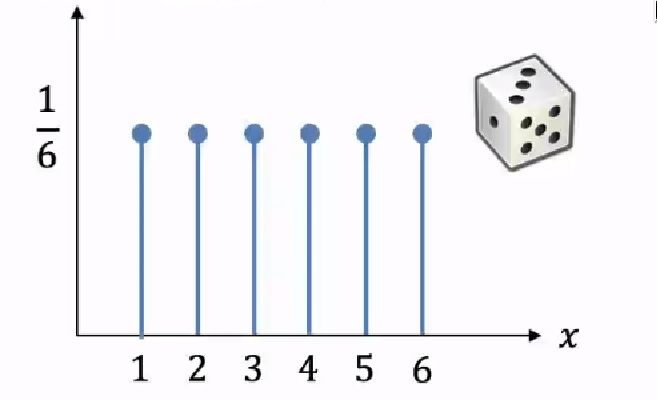
“Helen believes that the random variable C, representing cloud cover from the large data set, can be modelled by a discrete uniform distribution” How could you write down the probability distribution?
Use the fact that cloud cover can only be one of 9 possible values, so the probability of each case is $\frac{1}{9}$.