Further Maths - Volumes of Revolutions
Pearson Edexcel Further Mathematics 2022
What volumes of revolution are
In summary, what is volumes of revolutions?
Finding volumes by integrating.
If you have a function $f(x)$ and an interval $[a,b]$, how can you find the volume of revolution around the $x$-axis?
If normal integration is an infinite summation of rectangles, then volumes of revolutions is an infinite summation of?
Cylinders.
If you have a cylinder with radius $y$ and width $dx$, then what is the formula for the volume of that cylinder?
Rotating around each axis
If you have a function $y = ...$ on the interval $[a,b]$, how can you find the volume of revolution around the $x$-axis?
If you have a function $y = ...$ on the interval $[a,b]$, how can you find the volume of revolution around the $y$-axis?
Rearrange for $x = ...$
\[\int^b _ a \pi x^2 dx\]If you have a function $f(x)$ and an interval $[a,b]$, how can you find the volume of revolution around the $y$-axis?
Compound regions
How would you find the rotated volume of 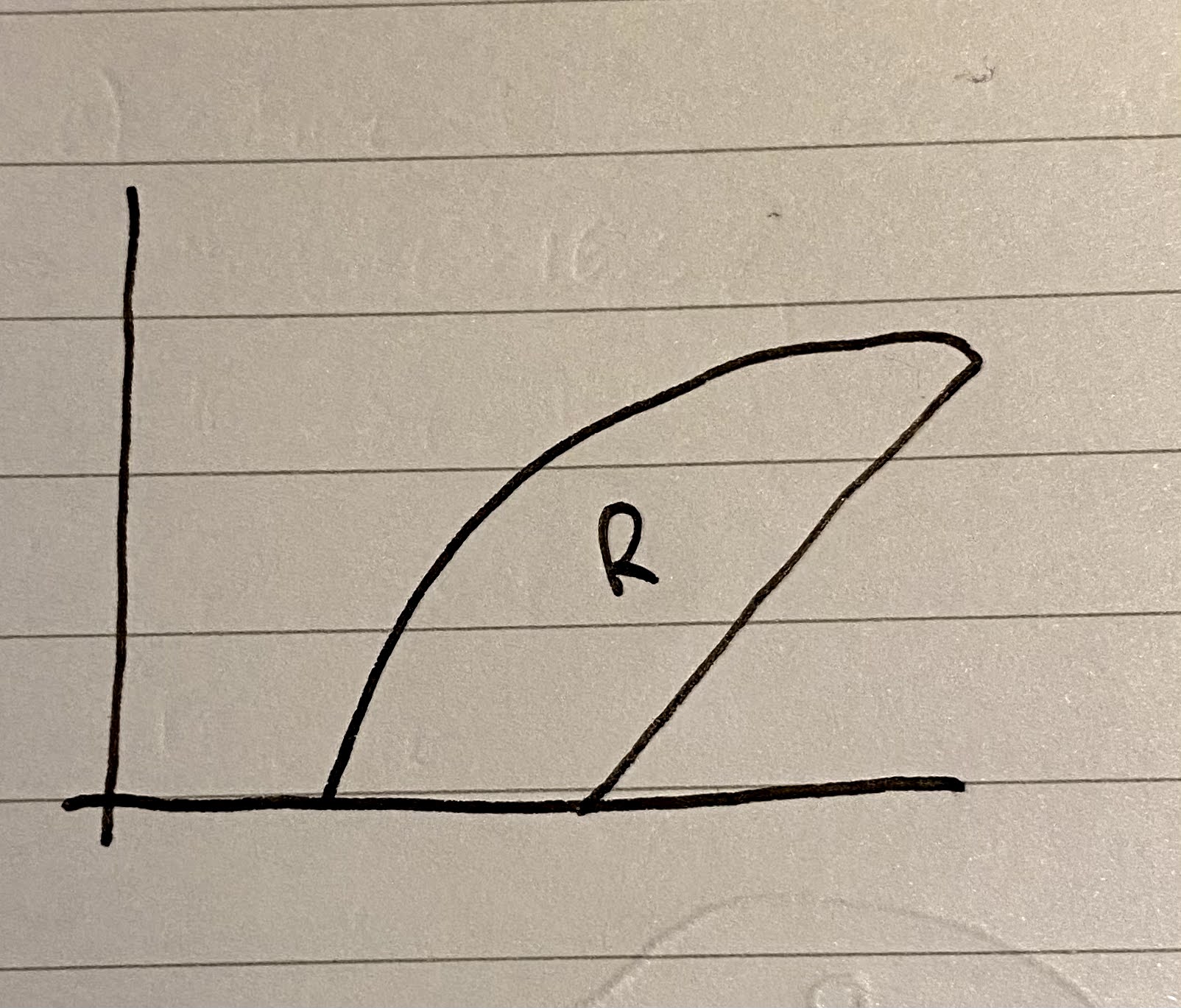


How would you find the rotated volume of
How would you find the rotated volume of
The cone shortcut
What’s easier than using volumes of revolution for a straight line like $y = 2x + 18$ or $2x + 3y - 5 = 0$?
Using the formula for the volume of a cone.
Parametric curves
What is the formula for the volume of revolution around the $x$-axis for a parametric curve defined with $x = f(t)$ and $y = g(t)$?
What is the formula for the volume of revolution around the $y$-axis for a parametric curve defined with $x = f(t)$ and $y = g(t)$?
What must you remember to do when integrating a parametric curve?
Change the limits so they are for $t$.
How could you summarise the change you make to a volumes of revolution formula for integrating parametric curve?
- Change limits
- Multiply $x^2$ or $y^2$ by the derivative of the other variable with respect to $t$.
If you normally use $y^2$ when finding the volume of revolution, how would this change for integrating parametrically?
If you normally use $x^2$ when finding the volume of revolution, how would this change for integrating parametrically?
Remembering to square
What do you always forget on volumes of revolution questions!!!?
Square the function!
“Hmmmm. Why isn’t this volumes of revolutions question working”?
You probably didn’t square the function.
Closed parametric curves
\[x = \cos\theta + \frac{1}{2}\sin 2\theta\]
\[y = -(1 + \cos\theta)\]
How could you tell that the $y$ limits for doing this parametric volumes of revolutions question for a closed curve was $0$ and $-2$?
It’s the “range of motion” for the $y$-component.