Further Maths - Conic Sections
Pearson Edexcel Further Mathematics 2022
Flashcards
Forming a parabola from a cone
How can you form a parabola from a cone?
Slice it parallel to its slope.
Why must you slice a cone PARALLEL to the slope to form a parabola?
Otherwise you’d either get an ellipse or intersect the cone twice and get a hyperbola.
Equations of a parabola
What is the parametric equation that defines a parabola?
When thinking about parabolas as a conic section, is it better to think of them symmetrical around the $x$-axis or $y$-axis?
$x$-axis.
Focus and directrix of a parabola
What is the focus-directrix definition of a parabola?
The locus of points that are the same distance from a fixed _ _ focus _ _ to a fixed straight line called the _ _ directrix _ _ .
What is the focus of a parabola?
The point that the locus must be the same distance to from the directrix.
What is the directrix of a parabola?
The line that the locus must be the same distance to from the focus.
What are the co-ordinates of the focus for a parabola $y^2 = 4ax$?
What is the equation of the directrix for a parabola $y^2 = 4ax$?
What are the co-ordinates of the vertex for a parabola $y^2 = 4ax$?
What is the Cartesian equation of the parabola with focus $(7, 0)$ and directrix $x + 7 = 0$?
If the focus of a parabola is $(5, 0)$, what is the equation of the directrix?
The rectangular hyperbola
How can you form a rectangular hyperbola?
Slice the cone perpendicular to its base so that it intersects both halves.
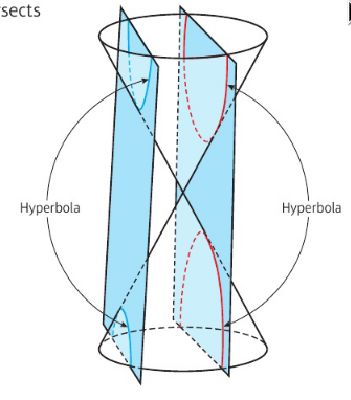
How can you form a hyperbola from a cone?
Slice the cone so that you intersect both halves.
What does the graph of a rectangular hyperbola look like on a pair of axes?
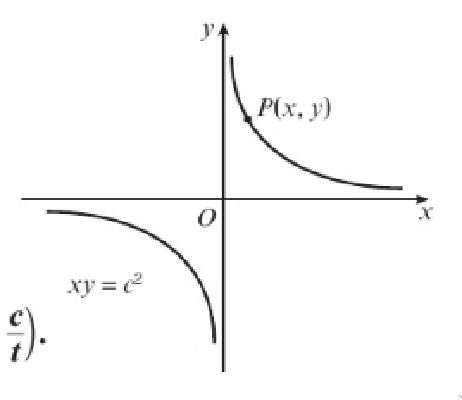
What is the nice, implicit equation for a rectangular hyperbola?
What is the parametric equation for a rectangular hyperbola?
What is special about a rectangular hyperbola compared to a normal hyperbola?
The asymptotes are perpendicular to each other (consider how the axes meet).
Where are the two asymptotes for a rectangular hyperbola?
At $x = 0$ and $y = 0$.
Tangents and gradients on conics
What two techniques could you use to work out the gradient at a point on a parabola $y^2 = 4ax$?
- Implicit differentiation and rearranging
- Parametric differentiation
How can you find the slope of the tangent to a rectangular hyperbola $(ct, c/t)$?
Use parametric differentiation.
How can you prove that a parabola is the locus of points an equal distance away from a focus and a directrix?
Set up a statement saying that the distances are equal and rearrange for $y^2 = 4ax$.
If the line with equation $y = mx + c$ is a tangent to the parabola with equation $y^2 = 4ax$, how could you show $a = mc$?
Set the $y$s equal to each other and use the fact the discriminant must be equal to $0$.
Equations of ellipses and hyperbolas
What is the general Cartesian equation for an ellipse?
In order to work out $a$ and $b$, what must every Cartesian ellipse equation be equal to?
If
\[4x^2 + 9y^2 = 36\]
how could you work out the values of $a$ and $b$ for the ellipse?
Divide both sides by $36$.
What is the parametric equation for an ellipse
\[\frac{x^2}{a^2} + \frac{y^2}{b^2} = 1\]
?
What is the general Cartesian equation for an hyperbola?
What are the two possible parametric equations for a hyperbola
\[\frac{x^2}{a^2} - \frac{y^2}{a^2} = 1\]
?
What is the advantage of using the $(\pm a\cosh t, b\sinh t)$ parametric equations over $(a \sec t, b \tan t)$?
You don’t need to specify a domain for $t$.
What is the domain for $t$ in the parametric equations for a hyperbola $(a \sec t, b \tan t)$?
Where are the asymptotes of a hyperbola
\[\frac{x^2}{a^2} - \frac{y^2}{b^2} = 1\]
?
Why aren’t most hyperbolas “rectangular” hyperbolas?
Because their asymptotes aren’t perpendicular to one another.
Eccentricity of a conic section
What is the eccentricity of a conic section?
The ratio of the distance to the focus vs the distance to the directrix.
If
\[\frac{\text{distance to focus}}{\text{distance to directrix}} = e\]
how can you work out the distance to the focus given the distance to the directrix?
If $e > 1$ then what conic section do you get?
A hyperbola.
Foci and directrices of an ellipse
What’s the general strategy for showing that a certain conic section has Cartesian equation given the locations of the foci and directrices?
Show that the squared distances are equal to a ratio.
When working out the eccentricity of an ellipse, what do you need to consider?
Whether $a > b$ or vice versa.
Why is it important whether $a > b$ or $b > a$ when working out the foci and directrices of an ellipse?
Because it’s like the ellipse has been rotated, so the foci and directrices need to be rotated too.
When $a > b$ what are the coordinates for the foci of an ellipse in terms of $a$ and $e$?
When $b > a$ what are the coordinates for the foci of an ellipse in terms of $b$ and $e$?
When $a > b$ what are the equations for the directrix of an ellipse in terms of $a$ and $e$?
When $b > a$ what are the equations for the directrix of an ellipse in terms of $b$ and $e$?
Proving Cartesian equations
If you’ve got to this stage
\[x^2(1 - e^2) + y^2 = a^2(1 - e^2)\]
when proving the Cartesian equation of a hyperbola, how can you flip it so you have a minus sign in front of the $y^2$?
Multiply the $(1 - e^2)$
\[x^2(e^2 - 1) - y^2 = a^2(e^2 - 1)\]How would you show that a certain parametric equation satisfies some sort of
\[f(x, y) = g(x, y)\]
?
Substitute in the parametric equation for both sides and verify that they’re equal.
Perpendicular foot and tangents
What is the “foot” of perpendicular from the origin to a line?
The point where you’d draw the little 90 degree square.
Is it better to use things like $\tanh$ or $\cot$, or things like $\frac{\sinh}{\cosh}$ or $\frac{\cos}{\sin}$ in conic sections questions?
The latter, keep it expanded