Maths - Cosine Rule
Pearson Edexcel Mathematics 2022
The two forms of the cosine rule
When to use the cosine rule
When can you use the cosine rule for working out the length of a side?
When you have SAS.
When can you use to cosine rule for working out an angle?
When you have only lengths.
Setting up the proof diagram
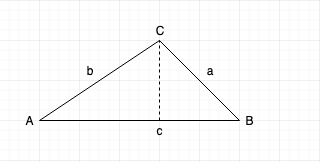
How is the start of the cosine rule proof similar to the start of the sine rule proof?
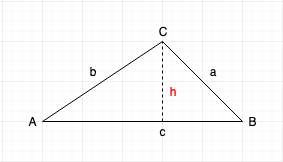
You drop a line $h$ down the centre of a triangle.
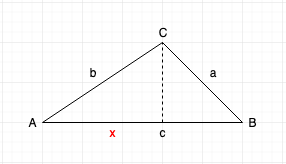
Along with $h$, what variable do you also introduce when starting the cosine rule proof?
$x$
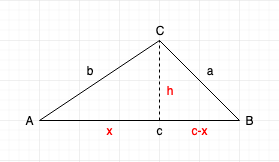
Pythagorean and trigonometric expressions
Combining and simplifying the expressions
Rearrange $b^2 = x^2 + h^2$ so $h^2$ is the subject of the formula?
Rearrange $a^2 = (c-x)^2 + h^2$ so $h^2$ is the subject of the formula?
If $h^2 = b^2 - x^2$ and $h^2 = a^2 - (c-x)^2$, then what must be true?
How could you simplify $b^2 - x^2 = a^2 - c^2 + 2cx + x^2$?
Eliminate $x^2$ from both sides.
Substituting $x = b\cos(A)$ into $b^2 = a^2 - c^2 + 2cx$ gives what formula?
The cosine rule.
Summary of the proof
What are the four main steps for proving the cosine rule?
- Drawing a diagram with two new variables
- Creating two expressions using the Pythagorean theorem
- Creating one expression using normal trigonometry
- Substituting